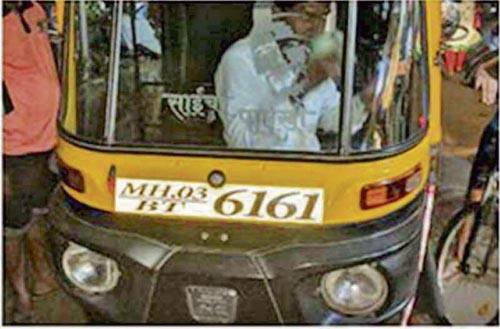
The auto rickshaw seized by the police
Rickshaw seized after meter tampering
Regardless of the assumption that electronic meters on autorickshaws are tamper-proof, of late there have been increasing incidents of passengers being overcharged by auto drivers who attach a pulse rate increasing device to the meters.
In a recent case, the Maghwadi police (Jogeshwari East) seized an autorickshaw belonging to Nitin Nadale (25) on charges of overcharging a passenger, Sachin Khetle, had hired the rickshaw (MH 03 BT 6161) from Karpurbawdi, Thane, to Jogeshwari on February 12.
Khetle, who regularly commutes between Thane and Jogeshwari, on reaching Meghwai, noticed that against normal fare of Rs 300, the meter was showing Rs 360. Besides, during the entire journey, the driver was seen frequently pressing a button of a device attached to the meter. Khetle took a photograph of the device and reported the matter to the Meghwadi police station.
Subsequently, members of the 'Janata Jagruti Manch' (JJM) also reported the matter to the police, but they failed to take cognisance of the matter. It was only later at the RTO's insistence that the rickshaw was seized. Shivaji Khairnar, Convenor of the JJM, told The Afternoon D & C that even today the driver is moving around scot-free since an FIR is yet to be registered against him.
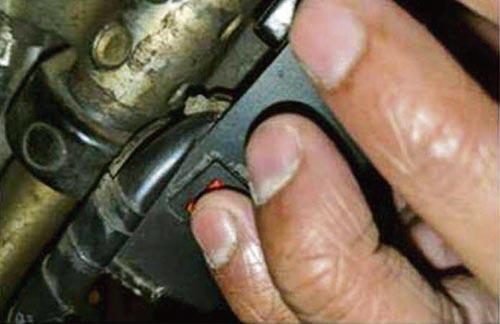
How the pulse rate can be increased by pressing the button
When contacted an officer at Meghwadi police station said that since the records are kept under lock and key, he was not in a position to say whether the FIR was lodged against the accused or not.
Apparently the police have booked the driver under provisions of the Motor Vehicles Act 1988, under the charge “no documents (license etc) was available”. But no sections of IPC have been applied.
Regional Transport Officer Purushottam Nikam of Wadala RTO said, “In such cases, an offence under Section 420 IPC should have been registered, which makes the crime non-bailable. He said the e-meters are tampered by fitting a device which facilitates increase in the pulse rate and automatically the fare goes up. In this case the accused had already removed the red button and the circuit of the meter before we could inspect the rickshaw. We will take action against Narale, who is also a permit holder and also against the meter manufacturer, the Maharashtra Institute of Technology (MIT), Pune. A show-cause notice has been issued against Narale and he has been asked to depose before us on February 20”.
However, according to an office bearer of the Mumbai Taxi-Autorickshaw Meter Repairers Association, there are many illegal shops specialising in tampering with e-meters. “Some time back we had been given a list of 18 businesses operating between Goregaon and Dahisar, 10 between Bhandup and Mulund and 17 in the Sion, Kurla, Bandra and Andheri areas to the RTOs. But they didn’t take any action and most of the shops continue to operate even today.”
There are three ways of tampering with an electronic meter — the switch and-mouse technique, the push button method and pulse doubling. The tampered electronic device has an option to switch back to normal mode, so that the driver can then show that the meter is functioning normally.

The push button attached to the metre.
Switch and mouse method
A small device — shaped like a computer mouse — is embedded with wires and a chip. This is connected to an on-off switch. The contraption is connected to the meter’s wires. When the switch is off, the meter will operate normally.
Push button method
Push button used in meters for taxis can also be used in autos. Two additional buttons — one at the extreme left and the other at the right — are installed in the meter. They are called F1 and F2. When the meter is started, it displays the fare for a normal ride. But if the F1 switch is pressed, the meter will start reading at the higher ‘night fare’ or ‘AC fare’. If F2 is pressed, it will show the ‘night AC fare’. This con game is usually pulled on passengers arriving from outside Mumbai by train or air.
Pulse doubling method
A magnet reads a pulse after every rotation of the motor. A second magnet would make the meter read two pulses for every rotation. For this purpose, a sensor is fitted with a magnet.